Which tubular battery is better for solar energy storage, telecom backup and industrial power systems? Explore the differences between flooded OPzS and sealed OPzV GEL batteries.
When selecting a reliable, long-life battery for solar energy storage, telecommunications or industrial backup power, OPzS flooded batteries and OPzV tubular GEL batteries are two widely used solutions.
Both technologies feature tubular positive plates, excellent deep-cycle performance and a design float life of over 20 years at 25°C.
However, they differ significantly in electrolyte technology, maintenance requirements, installation conditions and long-term operating costs.
For battery distributors, EPC contractors and project engineers, understanding these differences helps ensure the right battery is selected for each application.
1. OPzS vs. OPzV: What Is the Difference?
The main difference between OPzS and OPzV batteries lies in their electrolyte technology and maintenance requirements.
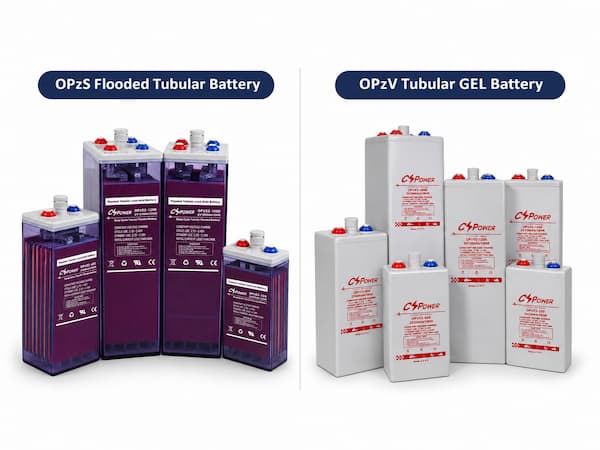
OPzS (Flooded Tubular Battery)
OPzS batteries use liquid sulfuric acid electrolyte and tubular positive plates. Their vented construction allows electrolyte levels to be checked, but periodic water replenishment and routine maintenance are required.
They are widely used in industrial battery rooms, solar energy storage systems and stationary backup power applications where maintenance personnel are available.
OPzV (Tubular GEL Battery)
OPzV batteries combine tubular positive plates with immobilized GEL electrolyte in a valve-regulated lead-acid (VRLA) design.
Unlike flooded batteries, OPzV batteries do not require routine water refilling, making them especially suitable for remote installations, telecommunications systems and projects where maintenance access is limited.
OPzS vs. OPzV Battery Comparison
| Feature | OPzS Flooded Battery | OPzV Tubular GEL Battery |
|---|---|---|
| Battery technology | Flooded tubular lead-acid | Valve-regulated tubular GEL |
| Nominal voltage | 2V | 2V |
| Capacity range | 100–3000Ah | 100–3000Ah |
| Electrolyte | Liquid sulfuric acid | Immobilized GEL electrolyte |
| Water refilling | Required periodically | Not required |
| Routine maintenance | Higher | Lower |
| Design float life at 25°C | Over 20 years | Over 20 years |
| Cycle performance at 80% DoD | Over 2,000 cycles | Over 2,000 cycles |
| Initial investment | Generally lower | Generally higher |
| Typical applications | Maintained industrial and solar installations | Remote solar, telecom and backup systems |
Key takeaway: Both technologies are designed for long-term performance. OPzS is often preferred when lower initial investment and regular maintenance are priorities, while OPzV offers advantages where reduced maintenance is particularly valuable.
2. Service Life and Deep-Cycle Performance
Long service life is one of the major advantages of tubular-plate battery technology.
CSPower OPzS and OPzV battery series are designed to deliver:
- Over 20 years of design float life at 25°C
- Over 2,000 cycles at 80% Depth of Discharge (DoD) under specified reference conditions
- Reliable performance in stationary backup and deep-cycle applications
Although their published design-life and cycle-life figures are similar, actual battery performance depends on operating conditions.
Float Life vs. Cycle Life
Float life is particularly important for UPS, telecommunications and emergency backup systems, where batteries remain on standby and discharge mainly during power interruptions.
Cycle life is more relevant to solar, wind and off-grid energy storage systems, where batteries undergo frequent charging and discharging.
The deeper a battery is discharged during each cycle, the greater the potential impact on its overall cycle life.
For this reason, battery selection should consider the actual discharge profile rather than relying only on nominal capacity or design-life figures.
How Does Temperature Affect Battery Life?
Operating temperature is another critical factor.
Both OPzS and OPzV batteries are lead-acid technologies, and prolonged exposure to elevated temperatures can significantly reduce their service life.
Correct charging voltage, temperature compensation and suitable ventilation are essential for maintaining long-term performance.
For projects in tropical regions or high-temperature industrial environments, battery temperature should be considered during system design.
Important: A design float life of over 20 years does not mean every battery will operate for more than 20 years under all conditions.
3. Maintenance Requirements and Total Cost of Ownership
While OPzS batteries generally offer a lower initial purchase cost, maintenance expenses can significantly affect the total cost of ownership.
OPzS: Cost-Effective with Proper Maintenance
OPzS batteries require periodic electrolyte inspection, water replenishment when necessary and routine maintenance.
They are an attractive option for installations with trained personnel and established maintenance procedures.
Typical advantages include:
- Competitive initial investment
- Proven tubular-plate technology
- Suitable for large stationary battery banks
- Long service life when properly operated and maintained
However, maintenance costs should be considered when the installation is located far from service teams.
OPzV: Reduced Maintenance for Remote Installations
The GEL electrolyte and valve-regulated design of OPzV batteries eliminate the need for routine water refilling.
This can reduce maintenance visits and simplify long-term battery management.
Typical advantages include:
- No routine water replenishment
- Reduced maintenance requirements
- Suitable for unattended and remote installations
- Good deep-cycle capability for renewable energy applications
However, OPzV batteries still require suitable ventilation, proper charging control and periodic system inspections.
The best battery is not necessarily the one with the lowest purchase price, but the one that offers the most suitable balance of performance, maintenance and lifecycle cost.
4. Which Battery Is Better for Your Application?
Different operating environments call for different battery solutions.
| Project Application | Suggested Battery | Main Reason |
|---|---|---|
| Remote off-grid solar system | OPzV | Reduced maintenance visits |
| Unattended telecom station | OPzV | No routine water refilling |
| Industrial battery room with maintenance staff | OPzS | Cost-effective with regular maintenance |
| Large stationary backup system | OPzS or OPzV | Depends on maintenance strategy and technical requirements |
| Daily-cycling solar energy storage | OPzS or OPzV | Depends on discharge profile and operating conditions |
| Maintenance-sensitive industrial project | OPzV | Lower routine maintenance requirements |
| Budget-sensitive project with qualified maintenance | OPzS | Potential initial cost advantage |
These are general selection guidelines. Actual project requirements, charging systems, ventilation conditions and maintenance arrangements should always be reviewed before making a final decision.
5. Battery Capacity and System Design: What Should Buyers Check?
Choosing between OPzS and OPzV is only the first step. Correct battery sizing is equally important.
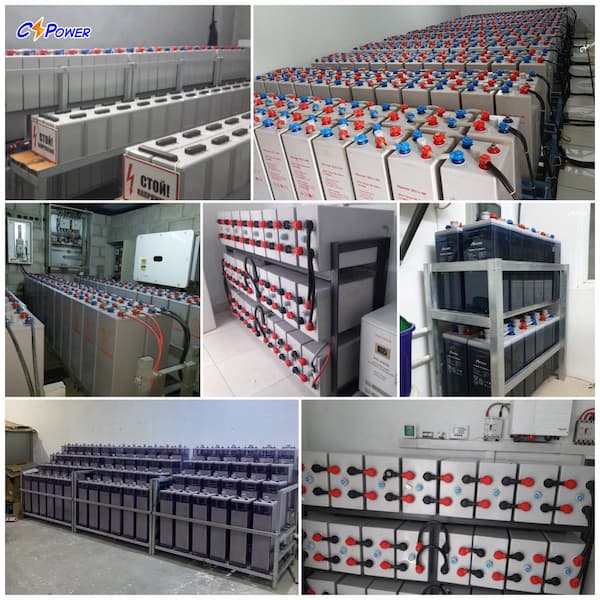
Both CSPower series offer 2V cells with capacities ranging from 100Ah to 3000Ah, allowing different battery bank configurations.
For example, a nominal 48V battery bank can be formed by connecting 24 individual 2V cells in series.
However, the required Ah capacity depends on several factors:
- System voltage and electrical load
- Required backup duration or daily energy consumption
- Maximum allowable depth of discharge
- Actual battery operating temperature
- Discharge rate and end-of-discharge voltage
- Charging equipment and maintenance conditions
A Practical Example: 2V 2000Ah Tubular Batteries
CSPower offers both OPzS2-2000 flooded batteries and OPzV2-2000 tubular GEL batteries.
Both have a nominal voltage of 2V and a rated capacity of 2000Ah at the 10-hour discharge rate (C10), at 25°C.
However, their reference datasheets specify different end-of-discharge voltages for the C10 rating:
- OPzS2-2000: 2000Ah at C10, to 1.85V per cell
- OPzV2-2000: 2000Ah at C10, to 1.80V per cell
This illustrates why batteries should not be compared based on nominal Ah ratings alone.
For accurate system design, engineers should review the model-specific discharge tables at the required discharge duration and end-of-discharge voltage.
Charging parameters must also follow the specifications of the selected battery type.
6. CSPower OPzS and OPzV Tubular Battery Solutions
With battery manufacturing experience dating back to 2003, CSPower supplies lead-acid and lithium battery solutions for international distributors, EPC contractors and OEM partners.
Our tubular battery range includes:
CSPower OPzS Flooded Tubular Battery
- 2V, 100–3000Ah
- Flooded electrolyte with tubular positive plates
- Over 20 years design float life at 25°C
- Over 2,000 cycles at 80% DoD under specified conditions
- Suitable for industrial backup and renewable energy storage applications
Explore CSPower OPzS Batteries
CSPower OPzV Tubular GEL Battery
- 2V, 100–3000Ah
- Valve-regulated GEL technology with tubular positive plates
- Over 20 years design float life at 25°C
- Over 2,000 cycles at 80% DoD under specified conditions
- No routine water refilling required
- IEC 60896 and IEC 61427 documentation available for applicable models, subject to report coverage
Explore CSPower OPzV Batteries
Both product series are available with CSPower branding or customized OEM branding to support different market requirements.
7. How to Choose the Right OPzS or OPzV Battery for Your Project
There is no single battery technology that is ideal for every installation.
Choose OPzS when:
- Lower initial investment is a major consideration
- Qualified maintenance personnel are available
- The battery system is installed in a suitable, maintained battery room
Choose OPzV when:
- The installation is remote or unattended
- Maintenance visits are difficult or expensive
- Routine water refilling is undesirable
- Reduced ongoing maintenance is a project priority
For either technology, proper battery sizing, compatible charging equipment, temperature management and installation safety requirements remain essential.
Need Help Selecting OPzS or OPzV Batteries?
Whether you are planning a solar energy storage system, a telecom backup installation or an industrial battery bank, CSPower can help review your technical requirements and recommend suitable battery configurations.
To receive a product recommendation or quotation, please share your project application, system voltage, required capacity or backup time, operating temperature, estimated quantity and destination country.
Contact CSPower Battery
WhatsApp / WeChat: +86 136 1302 1776
Email: jessy@cspbattery.com
Website: www.cspbattery.com
Technical Documents: CSPower Download Center
About CSPower Battery
Established in 2003, CSPower Battery (CS Energy Tech Co., Ltd.) specializes in lead-acid and LiFePO4 battery solutions for solar energy storage, telecommunications, UPS and industrial power applications.
CSPower supports overseas distributors, system integrators and OEM customers with battery manufacturing, product customization, technical documentation and project selection assistance.
Technical Note: The design-life and cycle-life figures above refer to published product-series performance under specified reference conditions. Actual performance varies with model, depth of discharge, charging parameters, temperature and operating conditions. Final battery selection should be based on the relevant model’s latest technical datasheet and project requirements.
Post time: Nov-04-2026